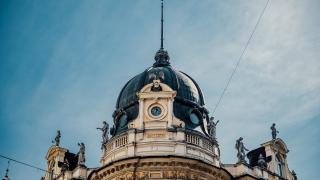
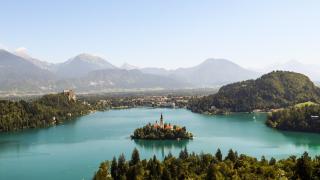
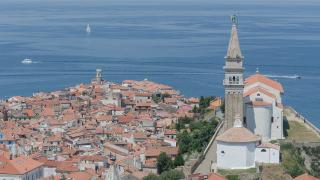
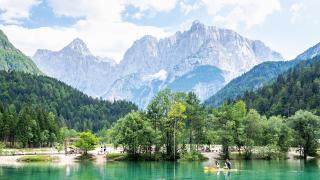
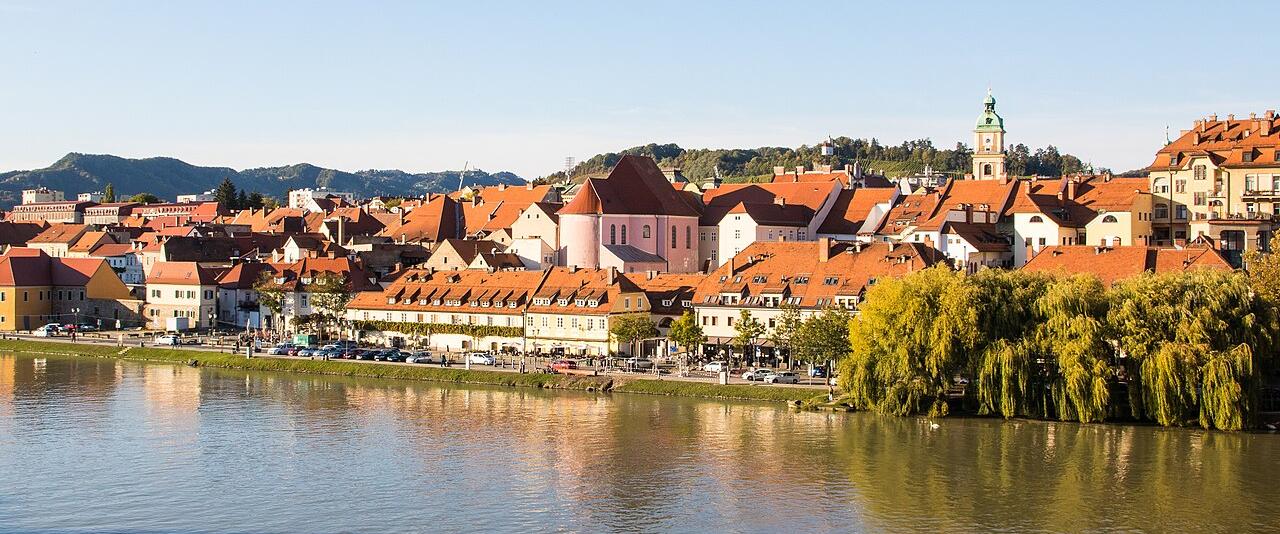
Maribor, Slovenia's second city, sits on the river Drava between vine-covered hills and the forested slopes of the Pohorje. Most visitors come for the wine and the skiing. Fewer know that it keeps the oldest vine in the world still bearing fruit, that its medieval synagogue is one of the oldest in Europe, or that a Maribor police officer saved a group of Jewish girls from the Nazis.
This is Maribor's bright side, in roughly the order it happened: what the city can claim, the people it is proud of, and the traditions it still keeps. Every chapter ends with something you can go and see.
The 14th Century: The Synagogue
Maribor had a Jewish community in the Middle Ages, and its synagogue, first mentioned in 1354, still stands on the riverbank in the old Jewish quarter. When the Jews were expelled from Styria in 1496–97, the building became a church, then a military warehouse and then a shop. It survived because it was useful.
In the 1990s the city restored it, and in 2001 it opened as a museum and cultural centre. It is one of the oldest preserved synagogues in Europe and the only medieval synagogue left in Slovenia. Next to it stands the Jewish Tower, part of the old city walls, now a photography gallery.
 The medieval synagogue of Maribor on the Drava, restored and opened as a museum in 2001. Image: Janezdrilc, CC0, via Wikimedia Commons.
 The Jewish Tower beside the synagogue. Image: Matic18, CC BY-SA 3.0, via Wikimedia Commons.
Where to see it today: the Synagogue Maribor, Židovska ulica 4, open on weekdays. It runs exhibitions and an annual "One Name Each Year" programme remembering individual people.
1555 and 1968: The Tower That Was Lifted
Along the river, the old town was defended by towers. The Water Tower, a round tower built in 1555 on the Lent riverfront, survived four centuries of floods. Then, in 1967–68, a new dam downstream raised the level of the Drava by about two and a half metres, and the tower was due to be demolished.
Instead, a Maribor builder had the tower, weighing about 1,500 tonnes, jacked up 2.6 metres with hydraulic lifts over seven months. It still stands, now above the water, and houses a wine shop and tasting room.
 The Water Tower of 1555 on the Drava, lifted 2.6 metres in 1968. Image: Ježofska, CC0, via Wikimedia Commons.
Where to see it today: the Water Tower on Usnjarska ulica, at the eastern end of the Lent riverfront. Upstream, the round Judgement Tower of 1310 completes the old defences.
 The Judgement Tower, the oldest of Maribor's surviving towers. Image: domjisch, CC BY 2.0, via Wikimedia Commons.
Over 400 Years Old: The Old Vine
On the front of a house on Lent grows the Old Vine (Stara trta). Guinness World Records lists it as the oldest vine in the world still bearing fruit. Its age is a range: a 1972 study gave at least 350 and perhaps 400 years, old paintings and engravings of the house from the 1650s to 1680s appear to show a vine on it, and the city now says more than 400 years. Its trunk is about 25 cm thick, and its branches spread along the façade.
Every year, at the end of September or the start of October, the Old Vine Festival ends with a ceremonial harvest of its grapes, usually a few dozen kilograms. The wine is bottled in fewer than 100 small 2.5 dl bottles, designed by a Slovene artist, and the city gives them as gifts to important visitors. One went to Pope John Paul II. Cuttings from the vine have been planted in other towns in Slovenia and abroad.
 The Old Vine on the façade of its house on Lent. Image: Marco Almbauer, CC BY-SA 4.0, via Wikimedia Commons.
 Grapes on the Old Vine. Image: Marco Almbauer, CC BY-SA 4.0, via Wikimedia Commons.
Where to see it today: the Old Vine House (Hiša Stare trte), Vojašniška ulica 8, reopened after renovation in December 2024. Entry is free; wine tastings cost extra.
1681 and 1743: Thanks for the End of a Plague
In 1680 plague killed about a third of the people of Maribor. In 1681 the survivors put up a column on the main square in thanks for its end. The column that stands there now was designed in 1743 by the sculptor Joseph Straub: white marble, with a gilded Virgin Mary standing on the moon, surrounded by six saints. The statue on the square today is a faithful copy put up around 1990; the weathered original is in storage.
 The Plague Column on Glavni trg. Image: Andrejj, CC BY-SA 3.0, via Wikimedia Commons.
Where to see it today: Glavni trg, Maribor's main square, next to the town hall.
1859: A Bishop Brings Learning
In 1859 Anton Martin Slomšek, the Bishop of Lavant, moved his diocese from St. Andrä in Carinthia to Maribor. It was a decision that changed the city: it brought a cathedral, a theological school, the first higher education in Maribor, and a centre for the Slovene language at a time when German dominated public life.
Slomšek wrote books for ordinary people, promoted Sunday schools where farm children learned to read in Slovene, and co-founded the Society of St Hermagoras, which grew into the oldest Slovene publishing house. He died in Maribor in 1862. On 19 September 1999, Pope John Paul II beatified him before a crowd of well over 150,000 people on the plain at Betnava, near Maribor. He was the first Slovene to be beatified.
 The 19th-century statue of Slomšek in Maribor Cathedral. Image: Sculpture: Franc Ksaver Zajec (1821-1888)Frame: Georg Härtl.Photo: Janezdrilc, Public domain, via Wikimedia Commons.
 Slomšek's tomb in the Chapel of the Holy Cross, Maribor Cathedral. Image: Janezdrilc, Public domain, via Wikimedia Commons.
Where to see it today: Maribor Cathedral, on Slomškov trg. His tomb is in the Chapel of the Holy Cross.
1868: The First Slovene Daily
On 2 April 1868 the first issue of Slovenski narod appeared in Maribor. Edited by Anton Tomšič, often called the first professional Slovene journalist, it became the first Slovene daily newspaper. It later moved to Ljubljana.
1883: Electric Light
In 1883 a Maribor mill owner lit his mill with electric light, among the very first electric lights on Slovene soil. In 1888 the same equipment lit up the castle square for a royal visit, though the streets kept their gas lamps until 1920.
1918: General Maister
At the end of the First World War, Austria-Hungary collapsed, and Maribor's future was uncertain: most of its townspeople were German-speaking, most of the surrounding countryside Slovene. On 1 November 1918 the Slovene National Council made Rudolf Maister, a Slovene army officer, a general. At four in the morning on 23 November his volunteers disarmed the German town guard and took the city with almost no bloodshed. The northern border he secured is, roughly, Slovenia's border today.
Maister was also a poet, who published two books of verse. Since 2005, 23 November has been a Slovene public holiday, Rudolf Maister Day.
 General Rudolf Maister. Image: Unknown authorUnknown author, Public domain, via Wikimedia Commons.
 Maister's call-up poster of November 1918. Image: Rudolf Maister, Public domain, via Wikimedia Commons.
Where to see it today: his statue on Trg generala Maistra, in front of the First Gymnasium, and his grave in Pobrežje cemetery.
1941: Sixteen Girls
In the winter of 1940–41, a group of 16 Jewish girls from Germany, sent by an underground network that helped Jewish children escape, reached Maribor on their way out of Nazi Europe. The border police commissioner, Uroš Žun, was under orders to turn them back. He disobeyed, stamped their papers, and arranged for the local Jewish community to house them in a hotel. When Germany occupied Maribor a few months later, the Germans put a price of 10,000 marks on his head, and he fled with his family. In 1986 Yad Vashem recognised him as Righteous Among the Nations.
Where to see it today: the Synagogue Maribor, which has told his story in its remembrance programme. A plaque to him is on his birth house in Radovljica.
1964: The Golden Fox
In 1964 three Maribor skiing enthusiasts organised a women's slalom race on the Pohorje, the mountain that rises straight from the edge of town. They called it the Zlata lisica, the Golden Fox. It joined the World Cup and ran on the Pohorje for decades, and in 1972 it hosted the first two-run women's giant slalom. The race moved to Kranjska Gora in 2019, but the slopes where it was born are still Maribor's own ski area, reached by cable car from the city's edge.
 The Mariborsko Pohorje ski slopes at night above the lights of the city. Image: Ratipok, CC0, via Wikimedia Commons.
Where to see it today: the Pohorje cable car from the southern edge of town. In winter there is night skiing above the city lights; in summer, hiking and mountain biking.
1975 and 2012: University and Culture
Slomšek's theological school became the root of the University of Maribor, founded in 1975, Slovenia's second university. In 2012 Maribor was a European Capital of Culture, together with Guimarães in Portugal, and in 2013 the European Youth Capital.
 The rectorate of the University of Maribor. Image: MPhernambucq, CC BY-SA 3.0, via Wikimedia Commons.
Every June: Festival Lent
In 1993 the city started a summer festival on the Lent riverfront to bring the old town back to life. Festival Lent has become the largest open-air summer festival in Slovenia, with music, theatre and dance on stages along the river. More than 12 million people have come since it began.
 Festival Lent on the Drava riverfront. Image: jad99 from Graz, Austria, CC BY-SA 2.0, via Wikimedia Commons.
 Fireworks over the Drava during Festival Lent. Image: Jernej Borovinšek, CC BY-SA 2.5 si, via Wikimedia Commons.
Where to see it today: be in Maribor in late June.
How to See Bright Maribor
A self-guided walk, about 3 km. Start on Glavni trg at the Plague Column, walk down to the river and along Lent past the Judgement Tower to the Old Vine House. Continue to the synagogue and the Jewish Tower, then the Water Tower at the end of the riverfront. Walk back up through the old town to the Cathedral and Slomšek's tomb, and finish at the statue of General Maister.
Further afield:
- The Pohorje, by cable car.
- The vineyard hills around the city, on the wine roads of Štajerska.
- The Vinag wine cellar, Trg svobode 3, about 2 km of tunnels under the city, with guided tours.
Dates to know:
- Late June: Festival Lent.
- Late September or early October: the Old Vine harvest.
- 23 November: Rudolf Maister Day.



.jpg)
.jpg)