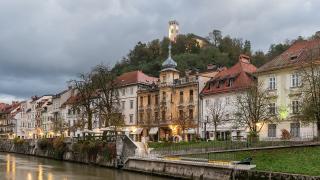
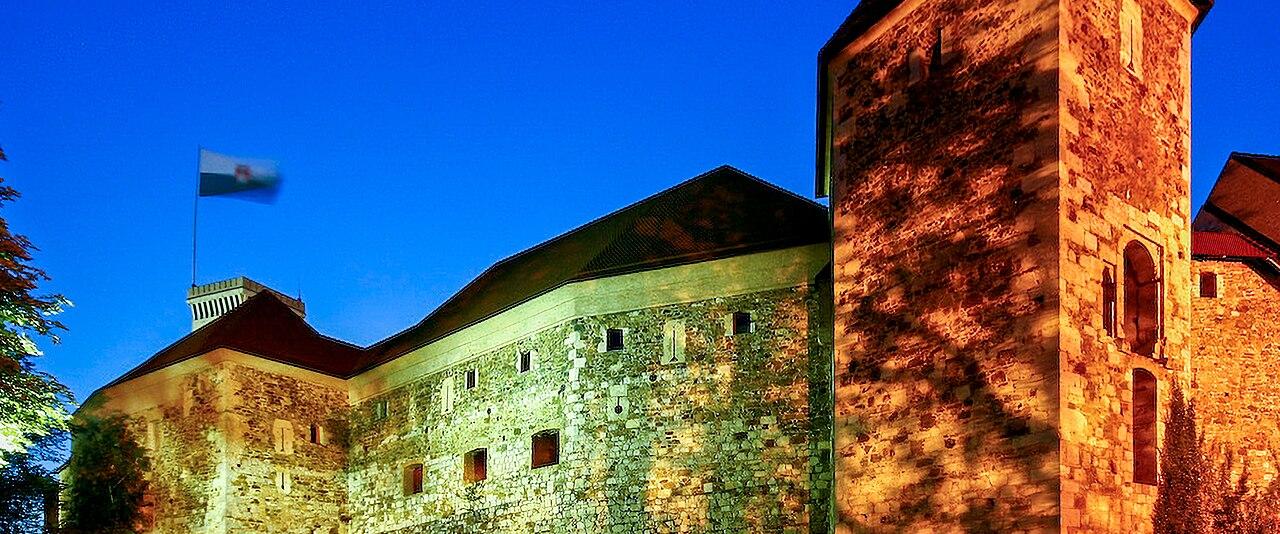
Ljubljana is the friendliest small capital in Europe: a green river lined with cafés, a car-free old town, a castle on a wooded hill. Under the dragons and the café umbrellas is a city that burned women as witches, ran a prison in its castle for most of a century, was shaken apart by an earthquake, and spent three years of the Second World War sealed inside a barbed-wire fence. After the war it held show trials in its courtrooms, and in 1992 the new state quietly deleted more than 25,000 of its own residents from the records.
Most of these chapters left something you can still find: a prison cell under the castle courtyard, a plague column, a 33-kilometre path where the fence once ran. This guide goes through them in order, from the witch trials to the present day, and tells you where to see each one. Some of the memorials are recent and some are still argued over, which is part of the story.
The 1690s: Witches in Carniola
Carniola, the old Habsburg province with Ljubljana as its capital, came late to witch-hunting and kept at it longer than most of Europe. The worst years came in the 1690s. The largest trial in the province was held at Poljane ob Kolpi between 1692 and 1699; another, at Ribnica in 1700–01, sent at least seven people to their deaths. The last known witch trial in Carniola was at Metlika, in 1746.
Ljubljana had its own trials, though the records are thin. Local tradition holds that a woman named Anica Gorjup, falsely accused in 1691, was the last person in the city to die at the stake. Historians know little about her beyond the name, so treat the story as tradition rather than established fact.
Where to see it today: there is no memorial. Ljubljana Castle runs an escape game, "Redeem the Witch", built around the city's witch trials.
Plague and the Holy Trinity Column
Plague returned to Carniola again and again in the 17th century, with epidemics in 1598–1600, 1623–27, 1631 and 1679–83. Like other Habsburg cities, Ljubljana answered with a vow. In 1693 a wooden votive column to the Holy Trinity went up at Ajdovščina; it was rebuilt in stone in 1722 by the builder Luka Mislej.
The better-known Marian column in front of St James's Church is often called a plague column too, but it began as a thanksgiving for a victory over the Ottomans in 1664. The column you see there now was designed by Jože Plečnik in 1938.
 The Holy Trinity column in front of the Ursuline Church, a votive against plague first raised in 1693. Image: Ajznponar, CC BY-SA 4.0, via Wikimedia Commons.
Where to see it today: the Holy Trinity Column stands in front of the Ursuline Church on Slovenska cesta, at the corner of Kongresni trg. The original sculpture is in the City Museum (Mestni muzej).
Two Earthquakes: 1511 and 1895
On 26 March 1511 an earthquake centred near Idrija killed about 3,000 people across the region. In Ljubljana the area around Križanke was hit hardest: the palace and church of the Teutonic Knights collapsed, and eight towers and part of the city wall fell or cracked.
The second earthquake made the city you see today. At 23:17 on Easter Sunday, 14 April 1895, a magnitude 6.1 tremor struck directly beneath Ljubljana, then a town of about 31,000 people and 1,400 buildings. About one building in ten was damaged badly enough that most of them had to be pulled down; on Špitalska ulica, today Stritarjeva, every house but one came down. The death toll was low for the destruction: 21 people across the region, with a few more killed later clearing rubble or by cold in the emergency shelters.
 Špitalska ulica after the earthquake of 14 April 1895, its houses propped up with timber. Photograph by Wilhelm Helfer. Image: Wilhelm Helfer, Public domain, via Wikimedia Commons.
The rebuilding was led by Ivan Hribar, who became mayor in 1896, on a town plan drawn by the architect Max Fabiani. Between 1895 and 1910 the city put up more than 400 new buildings, many of them in the Vienna Secession style, and in 1897 the first seismological observatory in Austria-Hungary opened on Vegova ulica.
Where to see it today: the Secession façades along Miklošičeva cesta, between Prešeren Square and the railway station, are the rebuilt city. Stritarjeva ulica, the street between the Triple Bridge and the cathedral, is the old Špitalska.
A Prison in the Castle
For most of the 19th century, Ljubljana Castle was a prison. It held prisoners from around 1815 until the 1895 earthquake ended its use as a penitentiary, with a break in the middle of the century. Its inmates included the Italian writer Silvio Pellico and the Hungarian prime minister Lajos Batthyány, who was executed in 1849. In the First World War the castle held prisoners of war, most of them Italian, and in 1914 the writer Ivan Cankar, Slovenia's best-known author, was briefly imprisoned here.
 The corridor of the restored solitary cells at Ljubljana Castle, now the Penitentiary exhibition. Image: David Jones from Isle of Wight, United Kingdom, CC BY 2.0, via Wikimedia Commons.
Where to see it today: the Penitentiary exhibition occupies the restored solitary cells below the Palatium. One cell keeps its original door and grilles; another shows the bone buttons prisoners wore. The castle is open every day of the year, from 9:00 to 19:00 (to 22:00 from May to September). Walk up or take the funicular from Krekov trg.
1942–1945: The City Inside the Wire
Italy occupied Ljubljana in April 1941 and annexed it as the "Province of Ljubljana". When armed resistance spread, the occupiers did something few occupied cities experienced. On the evening of 22 February 1942 Italian troops began fencing in the entire city with barbed wire, and by the next afternoon Ljubljana was sealed. People could leave or enter only through 11 checkpoints on the main roads.
The finished fence was almost 30 kilometres long and up to 8 metres deep, guarded from 206 bunkers. It stood until the end of the war, and the city remembers 1,171 days of isolation.
 Barbed wire around Ljubljana in 1942. Image: Unknown authorUnknown author, Public domain, via Wikimedia Commons.
Inside the ring, the occupiers took hostages. At Gramozna jama, a gravel pit on the northern edge of the city, Italian firing squads shot at least 185 people between 1942 and 1943, often as reprisals for partisan attacks and without trial. The first was killed on 7 February 1942; among the victims were the painter and cartoonist Hinko Smrekar, shot on 1 October 1942.
Where to see it today: the fence's route is now the Path of Remembrance and Comradeship (Pot spominov in tovarištva), a gravel path of about 33 kilometres around the city, lined with some 7,400 trees and 102 stone markers at the sites of the bunkers. Ljubljana walks and runs it every year on the weekend nearest 9 May, the day the city was liberated. The Gramozna jama memorial, by the western edge of Žale cemetery on Tomačevska cesta, is on the path.
 The Path of Remembrance and Comradeship, where the wartime fence once ran. Image: Petar Milošević, CC BY-SA 4.0, via Wikimedia Commons.
1945: The Killings After the War
The war ended in Slovenia with a civil war inside it. Thousands of Slovenes had fought on the German side in the Home Guard (Domobranci). In May and June 1945, after their surrender, the new communist authorities killed most of them without trial, along with other civilians they considered enemies.
The best-known killing sites, Kočevski Rog and Teharje, are outside the city, but Ljubljana has its own. The St Stanislaus Institute in Šentvid, a Catholic school, was turned into a camp in May 1945 from which prisoners were taken away to be shot. In the Big Brezar Shaft at Podutik, on the western edge of the city, about 800 people are estimated to have been killed at the end of May 1945.
 The grave site at the Big Brezar Shaft in the woods at Podutik. Image: Doremo, CC BY-SA 3.0, via Wikimedia Commons.
These killings could not be spoken of in Yugoslavia, and they still divide Slovenia. A monument to all victims of war, two tall pillars joined at the base, was unveiled on Kongresni trg in 2017, but a temporary model of it was vandalised several times before it went up, and it remains contested.
Where to see it today: the Monument to the Victims of All Wars stands on the south side of Kongresni trg, by Park Zvezda. The Brezar shaft and the graves outside the wall at Šentvid have plaques; both are in residential and wooded edges of the city, not on the tourist route.
Courtrooms, 1946–1949
The new regime made its point in Ljubljana's courtrooms. In August 1946 a military court tried the leaders of the collaboration. General Leon Rupnik, who had headed the German-backed provincial administration, was shot on 4 September 1946; SS general Erwin Rösener and the police chief Lovro Hacin were hanged. Bishop Gregorij Rožman was sentenced in his absence and died in exile in the United States in 1959. In 2020 Slovenia's Supreme Court annulled Rupnik's conviction on procedural grounds, a decision condemned by the country's Jewish community.
 Leon Rupnik in the dock at his trial in Ljubljana, August 1946. Image: Unknown authorUnknown author, Public domain, via Wikimedia Commons.
The next trials targeted people who had not collaborated at all. In the Nagode trial of 1947, fourteen non-communist intellectuals were accused of spying for the West. Črtomir Nagode was shot; two others were sentenced to death and had their sentences commuted. Between 1947 and 1949 the Dachau trials went further: former prisoners of the Dachau concentration camp, many of them communists, were accused of having collaborated with the Gestapo to survive. At least 10 were executed. The verdicts were annulled in 1986.
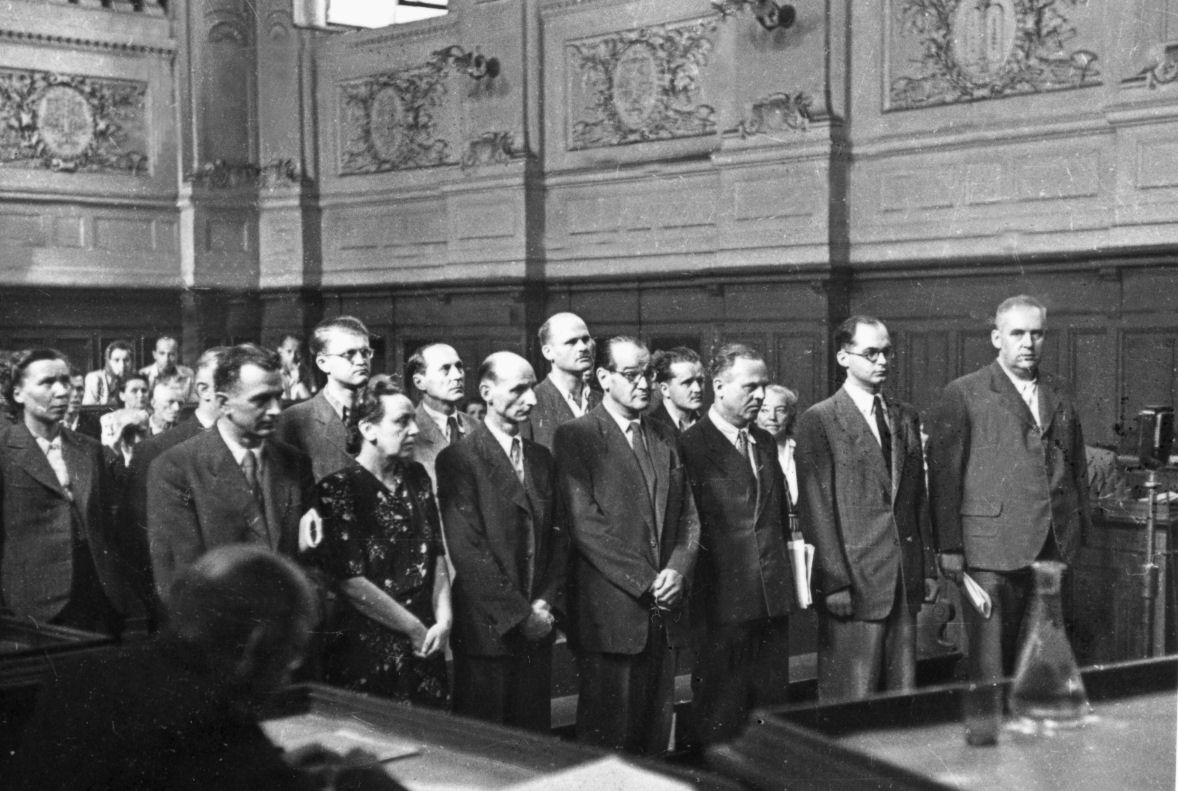 The defendants in the Nagode trial hear the indictment, Ljubljana, 1947. Image: Predsedstvo Republike Slovenije, Public domain, via Wikimedia Commons.
Where to see it today: no courtroom is open to visitors. The National Museum of Contemporary History in Tivoli Park, at Celovška cesta 23, covers the war, the post-war period and the trials.
Metelkova: From Barracks to Squat
The barracks on Metelkova street were built for the Austro-Hungarian army between 1882 and 1911 and later used by the Yugoslav People's Army. When Slovenia won its independence in 1991, the army left. On 9 and 10 September 1993, artists and activists occupied the site to stop the city demolishing it. They never left.
Metelkova mesto is now an autonomous cultural centre of clubs, studios and galleries, without legal status and covered in sculpture and murals. The former military prison next door became Hostel Celica in 2003, its cells redesigned by artists as guest rooms.
 Metelkova mesto, the former army barracks occupied in 1993. Image: Rok, CC BY-SA 2.0, via Wikimedia Commons.
Where to see it today: Metelkova mesto is a few minutes' walk east of the railway station; it is quiet by day and busy at night. Hostel Celica is next door; ask at reception whether non-guests can see the cells.
1992: The Erased
On 26 February 1992, eight months after independence, the Slovenian interior ministry removed 25,671 people from the register of permanent residents. Most were citizens of other Yugoslav republics who had lived in Slovenia for years, often decades, and had not applied for Slovenian citizenship in time. They were not told. Overnight they lost their right to work, to healthcare and to a pension; some were deported.
Slovenia's Constitutional Court ruled the erasure unlawful in 1999 and again in 2003. In 2012 the European Court of Human Rights found that Slovenia had violated the rights of the Erased, and in 2013 the country passed a compensation law.
Where to see it today: a monument shaped like the accent on the letter "Ć", common in surnames from the other former Yugoslav republics, was unveiled in 2023 in the Park of the Erased (Park izbrisanih), in the courtyard of the former Rog factory by the Ljubljanica.
Today's Shadows
Ljubljana is one of the safest capitals in Europe, but it has its own tensions.
- Metelkova and the station area. In January 2026 the police declared the streets between Metelkova, the railway station and Tabor Park a security-risk zone, allowing extra camera surveillance because of street drug dealing. The cultural centre itself rejects the blame.
- Overtourism. About 1.3 million foreign tourists came in 2024, more than twice as many as a decade earlier, in a city of under 300,000. In surveys, more than 40% of residents say crowding bothers them, and the old town's flats have been turning into holiday lets.
How to visit: Metelkova is a place where people make art and live, not a theme park; ask before photographing people, and don't buy anything offered on the street.
How to See Dark Ljubljana Respectfully
A self-guided walk, about 4 km. Start at the castle and the Penitentiary cells, then walk down to the old town and along Stritarjeva ulica, the street rebuilt after 1895. Cross the river to Kongresni trg for the Holy Trinity Column and the Monument to the Victims of All Wars. Continue north along Miklošičeva cesta and its post-earthquake façades, then east past the station to Metelkova and Hostel Celica. Finish at the Park of the Erased by the old Rog factory, back on the river.
Further afield:
- The Path of Remembrance and Comradeship, best by bike; Gramozna jama is on its northern stretch.
- The National Museum of Contemporary History in Tivoli Park.
- The Big Brezar Shaft at Podutik and the graves at Šentvid.
Dates to know:
- 14 April: the 1895 earthquake.
- 9 May: liberation day, with the walk along the wartime fence.
- 26 February: the anniversary of the erasure.
A few ground rules. Many of these places are graves or execution sites, some still in dispute; keep them quiet and don't treat them as backdrops. At Metelkova, respect the residents and artists. And on the Path of Remembrance, keep to the path: it runs through parks, allotments and backyards.


.jpg)
.jpg)


.jpg)

.jpg)