
Slovenia's Three Wine Regions
Slovenia is a small country with a long wine history, and its vineyards fall into three official regions. Primorska in the west, near Italy and the Adriatic, is the warmest. Posavje in the southeast, along the Sava, is the smallest. Podravje in the northeast, named after the Drava, is among the largest producers. Each region is divided into districts with their own grapes and traditions, and many are signposted as wine roads (vinske ceste) that link wineries, farms and villages.
A road trip covering all three regions is possible in a week. With less time, it is better to pick one or two regions and go slowly.
Goriška Brda
Brda is a district of steep hills on the Italian border, often compared with neighbouring Collio in Italy, which is part of the same landscape. Its signature white grape is Rebula (Ribolla Gialla), made in styles ranging from fresh and light to long, skin-contact "orange" wines. Brda is also known for cherries, which ripen in late spring.
The medieval village of Šmartno, with its walls and narrow streets, is a good base for a walk. The Gonjače lookout tower gives a wide view over the vineyards towards the Alps and the Adriatic.
The Vipava Valley and the Karst
Southeast of Brda, the Vipava Valley is the largest district in Primorska. The bora wind that blows through the valley shapes both the vines and the villages. Look for two native white grapes, Zelen and Pinela, which are rarely found elsewhere.
South of Vipava, the Karst (Kras) plateau has thin red soil over limestone. Its best-known wine is Teran, a deep red made from the Refošk grape, traditionally paired with air-dried Karst ham (kraški pršut). In the Karst and Vipava you may also come across an osmica, a traditional, temporary opening when a farm sells its own wine and home-produced food for a limited number of days. Dates are announced locally and change each year.
Slovenian Istria, the fourth Primorska district on the coast, is known for Malvazija and Refošk.
Posavje: Cviček and Bizeljsko
The southeastern region is less visited by foreign travellers. Its best-known wine is Cviček, a light, low-alcohol blend of red and white grapes from the Dolenjska district. Bela Krajina, further south near the Croatian border, is known for Metliška črnina, a red blend, and for Blaufränkisch (Modra frankinja).
In the Bizeljsko-Sremič district, look for the repnice, cellars dug into sand deposits, traditionally used to store wine and vegetables at a stable temperature.
Podravje: Štajerska and Prekmurje
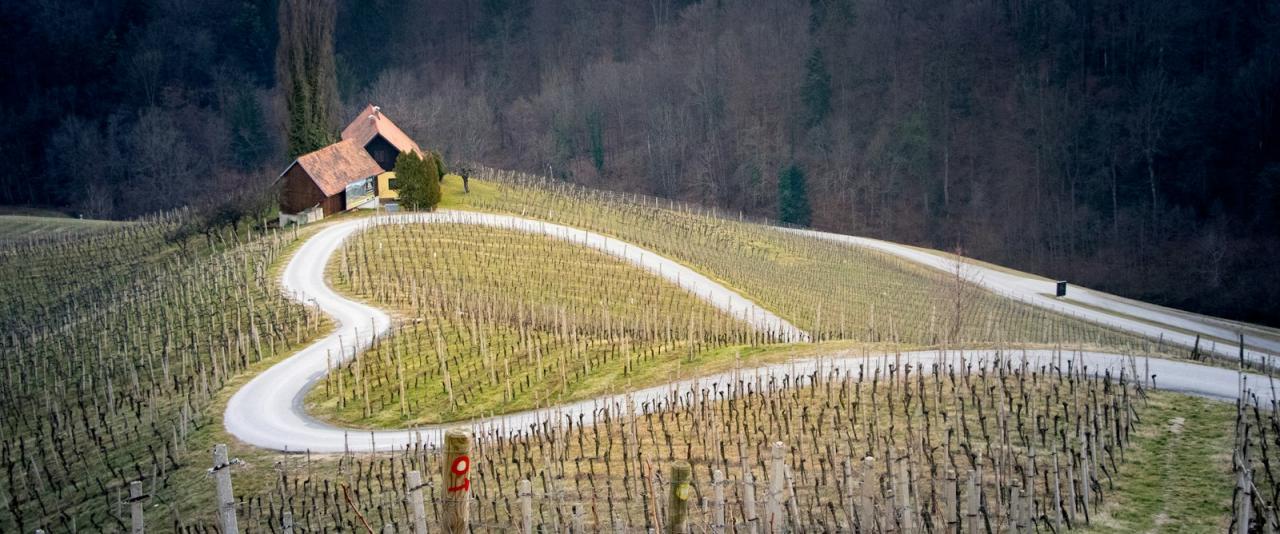
The northeast is the heartland of Slovenian white wine. The Jeruzalem hills, between Ljutomer and Ormož, have steep terraced vineyards and are known for Šipon (Furmint) and Laški rizling (Welschriesling). The winding road through the Slovene Hills (Slovenske gorice) passes vineyards, small wineries and tourist farms.
In Maribor, the Old Vine House on the Drava riverside displays the Old Vine, a Žametovka vine reported to be around 400 years old and listed by Guinness World Records as the oldest living vine still producing grapes. Ptuj, the oldest town in Slovenia, has a historic wine cellar that you can visit. Near Gornja Radgona, the Radgona hills are known for a long tradition of sparkling wine.
Planning Visits
- Book ahead: Many wineries are small family businesses and do not have staff waiting for walk-in visitors. Phone or email in advance, especially for weekday visits.
- Use the local tourist offices: Brda, Vipava, Ptuj, Maribor and Ljutomer all have tourist information centres that can suggest wineries open to visitors.
- Combine wine with food: Tourist farms (turistične kmetije) serve home cooking alongside their own wine and often have rooms, which removes the need to drive after dinner.
- Seasons: Spring and early autumn are the most pleasant times. The grape harvest usually runs from September into October, when wineries are busy but the vineyards are at their most active.
Driving and Drinking
Slovenia enforces drink-driving limits strictly, with a zero limit for some groups such as new drivers, and police checks are common in wine areas. Choose a designated driver, spit at tastings, or stay overnight close to the wineries you visit. Using Slovenian motorways requires an electronic vignette, which you need to buy before driving on them.