The Slovenian phrases you will use most are dober dan (hello, literally "good day"), hvala (thank you), prosim (please, and also "you're welcome") and na svidenje (goodbye). Learn those four and you can be polite almost anywhere. Most Slovenians who work with visitors speak English, especially younger people, so you won't need the language to get by. Still, a few words of Slovenian are noticed and appreciated, because few visitors try.
Below are 58 useful words and phrases, grouped by situation, with a simple pronunciation guide (the stressed syllable is in capitals). After that come the few sounds that catch English speakers out, the grammar quirk that makes Slovenian unusual in Europe, and which other languages you can fall back on in each region.
Quick facts
- Language: Slovenian (slovenščina), a South Slavic language, closely related to Croatian but not the same.
- Speakers: about 2.5 million, most of them in Slovenia.
- Official status: Slovenian is official throughout the country. Italian is also official in the ethnically mixed areas on the coast, and Hungarian in Prekmurje in the north-east.
- Alphabet: Latin letters plus č, š and ž, without q, w, x or y.
- Dialects: more than 50, in 7 dialect groups, according to the Slovenian Tourist Board.
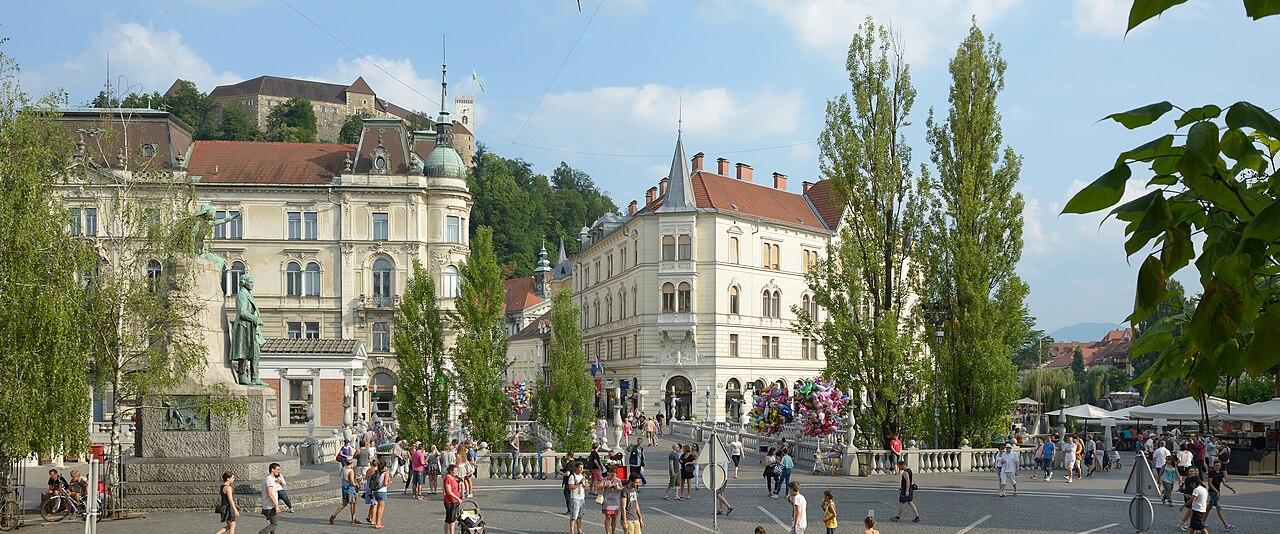
 Prešeren Square in Ljubljana, named after France Prešeren, the national poet who wrote in Slovenian. Image: This Photo was taken by Wolfgang Moroder. Feel free to use my photos, but please, CC BY-SA 3.0, via Wikimedia Commons.
How do you pronounce Slovenian?
Slovenian spelling is mostly phonetic: each letter has one sound, and you pronounce every letter. These are the ones to learn:
- c = "ts", as in cats: cesta (road) is TSEH-stah.
- č = "ch", as in church: večer (evening) is veh-CHER.
- š = "sh": šola (school) is SHOH-lah.
- ž = "zh", like the s in pleasure: žganje (fruit brandy) is ZHGAHN-yeh.
- j = "y", as in yes: jutro (morning) is YOO-troh.
- r is rolled, and it can stand in for a vowel: trg (square) is roughly "terg". The Slovenian name for Trieste is Trst.
- v before a consonant or at the end of a word sounds closer to "w" or "u": avtobus (bus) is AHW-toh-boos.
- lj and nj are single sounds, roughly "ly" and "ny": Ljubljana is lyoob-LYAH-nah.
Stress has no fixed rule, so don't worry about getting it perfect. People will understand you.
Greetings and basics
- Dober dan (DOH-ber DAHN): hello / good day (all day)
- Dobro jutro (DOH-broh YOO-troh): good morning
- Dober večer (DOH-ber veh-CHER): good evening
- Lahko noč (lah-KOH NOCH): good night
- Živjo / Zdravo (ZHEE-vyoh / ZDRAH-voh): hi (informal)
- Na svidenje (nah SVEE-den-yeh): goodbye
- Adijo (ah-DEE-yoh): bye (informal)
- Hvala / Hvala lepa (HVAH-lah / HVAH-lah LEH-pah): thank you / thank you very much
- Prosim (PROH-seem): please / you're welcome / pardon?
- Ni za kaj (NEE zah kai): don't mention it
- Ja / Ne (yah / neh): yes / no
- Oprostite (oh-proh-STEE-teh): excuse me / sorry
- Kako ste? (KAH-koh steh): how are you? (polite)
- Dobro, hvala (DOH-broh, HVAH-lah): fine, thanks
- Me veseli (meh veh-SEH-lee): pleased to meet you
- Ime mi je … (ee-MEH mee yeh): my name is …
- Ne razumem (neh rah-ZOO-mem): I don't understand
- Govorite angleško? (goh-voh-REE-teh ahn-GLESH-koh): do you speak English?
- Počasi, prosim (poh-CHAH-see, PROH-seem): slowly, please
- Kje je stranišče? (KYEH yeh strah-NEESH-cheh): where is the toilet?
Slovenian has a polite "you" (vi) and an informal one (ti). Use the polite forms above with anyone you don't know. Živjo and adijo are for friends, young people and relaxed settings; dober dan and na svidenje are always safe.
 Fruit stalls at Ljubljana's Central Market, where a few words of Slovenian go a long way. Image: domdomegg, CC BY 4.0, via Wikimedia Commons.
At a restaurant or café
- Mizo za dva, prosim (MEE-zoh zah DVAH, PROH-seem): a table for two, please
- Jedilni list, prosim (yeh-DEEL-nee LEEST): the menu, please
- Kaj priporočate? (KAI pree-poh-ROH-chah-teh): what do you recommend?
- Pivo, prosim (PEE-voh, PROH-seem): a beer, please
- Kozarec vode (KOH-zah-rets VOH-deh): a glass of water
- Kozarec belega / rdečega vina (KOH-zah-rets BEH-leh-gah / er-DEH-cheh-gah VEE-nah): a glass of white / red wine
- Kava z mlekom (KAH-vah z MLEH-kom): coffee with milk
- Sem vegetarijanec / vegetarijanka (sem veh-geh-tah-ree-YAH-nets / -YAHN-kah): I'm vegetarian (man / woman)
- Imam alergijo na … (EE-mahm ah-ler-GEE-yoh nah): I'm allergic to …
- Dober tek! (DOH-ber TEK): enjoy your meal!
- Na zdravje! (nah ZDRAHV-yeh): cheers!
- Račun, prosim (rah-CHOON, PROH-seem): the bill, please
- Lahko plačam s kartico? (lah-KOH PLAH-chahm s KAR-tee-tsoh): can I pay by card?
- Bilo je zelo dobro (BEE-loh yeh ZEH-loh DOH-broh): It was very good
A gostilna is a traditional inn serving home cooking, and the word is on signs all over the country. Dober tek is said by the waiter as the food arrives and between friends before they eat. Say it back.
 A gostilna, a traditional inn, on the main square of Radovljica. Image: Johann Jaritz, CC BY-SA 3.0, via Wikimedia Commons.
 A slice of kremšnita, the cream cake that Bled is known for. Ask for "eno kremšnito, prosim". Image: Petar Milošević, CC BY-SA 4.0, via Wikimedia Commons.
Getting around
- Kje je …? (KYEH yeh): where is …?
- avtobusna postaja (AHW-toh-boos-nah POH-stah-yah): bus station
- železniška postaja (zheh-LEZ-neesh-kah POH-stah-yah): railway station
- letališče (leh-tah-LEESH-cheh): airport
- Ena vozovnica do Bleda, prosim (EH-nah voh-ZOHW-nee-tsah doh BLEH-dah): one ticket to Bled, please
- povratna vozovnica (poh-VRAHT-nah voh-ZOHW-nee-tsah): return ticket
- Kdaj pelje naslednji avtobus? (GDAI PEL-yeh nah-SLED-nyee AHW-toh-boos): when does the next bus leave?
- Ali gre ta avtobus v Piran? (AH-lee GREH tah AHW-toh-boos oo pee-RAHN): does this bus go to Piran?
- levo / desno / naravnost (LEH-voh / DES-noh / nah-RAHW-nost): left / right / straight on
- Kako daleč je …? (KAH-koh DAH-lech yeh): how far is …?
- prihodi / odhodi (pree-HOH-dee / od-HOH-dee): arrivals / departures
Place names change their endings after do (to): do Ljubljane, do Bleda, do Pirana. If you just say the name in its normal form, the ticket seller will still understand. For buses, trains and the airport, see our guide to getting around Slovenia and our Ljubljana airport transfers guide.
 "Avtobusna postaja" means bus station: the main bus station in Ljubljana. Image: Aplslo, CC BY-SA 4.0, via Wikimedia Commons.
Shopping
- Koliko stane? (KOH-lee-koh STAH-neh): how much is it?
- To, prosim (TOH, PROH-seem): this one, please
- Samo gledam (SAH-moh GLEH-dahm): I'm just looking
- Imate …? (EE-mah-teh): do you have …?
- odprto / zaprto (OD-pr-toh / ZAH-pr-toh): open / closed
- vhod / izhod (VHOD / EEZ-hod): entrance / exit
- trgovina / lekarna (ter-GOH-vee-nah / leh-KAR-nah): shop / pharmacy
Emergencies and health
- Na pomoč! (nah poh-MOCH): help!
- Pokličite rešilca! (pok-LEE-chee-teh reh-SHEEL-tsah): call an ambulance!
- Pokličite policijo! (pok-LEE-chee-teh poh-lee-TSEE-yoh): call the police!
- Potrebujem zdravnika (poh-treh-BOO-yem zdrahw-NEE-kah): I need a doctor
- Slabo mi je (SLAH-boh mee yeh): I feel ill
- Izgubil(a) sem potni list (eez-GOO-beel(-ah) sem POT-nee LEEST): I've lost my passport (man / woman)
In an emergency, dial 112 for an ambulance, the fire service or rescue, and 113 for the police. They work from any phone, including a foreign mobile.
 A platform sign: "Ne hodi čez progo, je smrtno nevarno" ("Don't cross the tracks, it's deadly dangerous"). Image: Alexwlchan, CC BY-SA 4.0, via Wikimedia Commons.
What is the Slovenian dual form?
Slovenian is one of very few living languages that still has a dual: a separate grammatical number for exactly two of something, alongside singular and plural. Most Indo-European languages lost it centuries ago. In Slovenian, nouns, adjectives, pronouns and verbs all change for two.
You'll hear it when ordering:
- eno pivo (one beer), dve pivi (two beers), tri piva (three beers), pet piv (five beers)
- en kozarec (one glass), dva kozarca (two glasses), trije kozarci (three glasses)
It applies to people too. Kako ste? is "how are you?" to one person (politely) or to three or more, but to a couple you say Kako sta? And "the two of us" is midva. You don't need to use the dual yourself, because people will understand you without it. But if a waiter asks a couple "Kaj bosta?" (What will you two have?), you'll know why the ending sounds different.
Do people in Slovenia speak English?
Yes, widely, especially younger people and anyone working in tourism, transport or hotels. English and German are the most commonly taught foreign languages in Slovenian schools, and Eurostat data show Slovenians know German better than people in any other non-Germanic country except Luxembourg, the Netherlands and Denmark. Many older Slovenians grew up with Serbo-Croatian in Yugoslavia and still speak it well.
Which second language is most useful depends on where you are:
- The coast (Koper, Izola, Piran, Ankaran): Italian is an official language here alongside Slovenian, and street names, public signs and town-hall plaques are bilingual. Piran is also Pirano, and Koper is Capodistria.
- Prekmurje, near Lendava: Hungarian is official in the Hungarian community's home municipalities, again with bilingual signs.
- Gorenjska and Styria (the Alps and the north-east): German is common, particularly among older people and in places with many Austrian and German visitors.
 A bilingual Slovenian and Italian sign at Piran's town hall: Občina Piran, Comune di Pirano. Image: HartemLijn, CC BY-SA 4.0, via Wikimedia Commons.
Is Slovenian the same as Croatian or Slovak?
No to both. Slovenian and Croatian are related South Slavic languages, and speakers can partly understand each other, but vocabulary, grammar and pronunciation differ (Croatian has no dual, for one). Slovak is a West Slavic language spoken in Slovakia, and the similar names are a common source of confusion. Slovenians notice when you get the name right: the language is slovenščina, the people are Slovenci, and "I don't speak Slovenian" is Ne govorim slovensko (neh goh-VOH-reem sloh-VEN-skoh).
Tips for using your Slovenian
- Start with dober dan. It works as hello at any time of day, in shops, cafés and on buses, and people will often reply in English once they hear your accent.
- Say hvala often. It's the word you'll use most.
- Use prosim for almost everything: asking for something, handing something over, or asking someone to repeat themselves.
- Don't worry about grammar. Endings change a lot in Slovenian, but the basic form of a word is nearly always understood.
- Learn to read signs. Odprto, zaprto, vhod, izhod, prihodi and odhodi will help you even when you aren't speaking.