Getting There and Parking
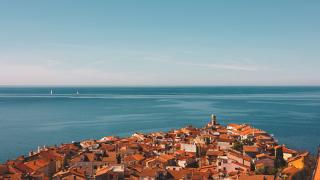
Piran sits at the tip of a narrow peninsula on Slovenia's short Adriatic coast, and its old town is not built for cars. Visitor traffic into the historic centre is restricted: drivers can enter briefly to drop off passengers or luggage, but are expected to park outside. The usual choice is the Fornače garage just south of the centre, which is linked to Tartini Square by a shuttle bus. The Arze garage and the open car park next to it are alternatives, about 15 minutes' walk from the centre, with an uphill walk back. Parking tariffs change and published figures disagree, so check the current price list from the municipal operator, Okolje Piran, before you go.
Without a car, the simplest route is by bus. Piran has direct buses from Ljubljana and frequent local buses along the coast from Koper and Portorož. The nearest railway station is in Koper, from where you continue by bus.
Saturday Morning: Tartini Square
Start where everyone starts, on Tartini Square. It was once the town's inner harbour, filled in during the 19th century, which explains its oval shape. The square is named after Giuseppe Tartini, the violinist and composer born in Piran in 1692, and his bronze statue stands in the middle. Tartini's birthplace is on the square and is open as a small memorial house.
Look for the Venetian House, a narrow red Gothic building on the corner, with its stone balcony and the inscription "Lassa pur dir" ("Let them talk"). From the square, narrow lanes lead uphill and along the water. The old town is small enough to walk end to end in half an hour, so take it slowly and go into the side streets rather than staying on the waterfront.
The Church of St George and the Town Walls
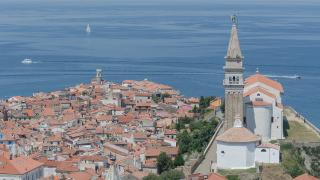
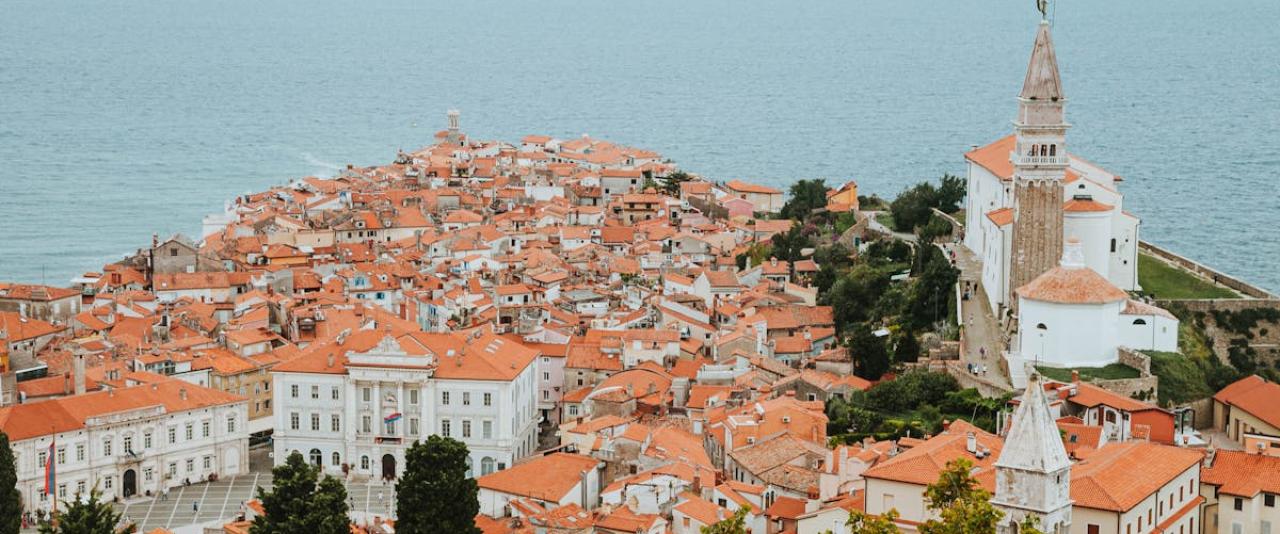
Climb from the square to the Church of St George, which sits on a ridge above the town. Its free-standing bell tower is modelled on the campanile of St Mark's in Venice, a reminder that Piran was under Venetian rule for centuries. The terrace beside the church overlooks the sea on one side and the rooftops on the other, and on clear days you can see across the Bay of Trieste.
Further up the hill, a preserved stretch of the medieval town walls runs along the ridge. A small fee is charged to walk the battlements, and the view down over the church, the square and the harbour is the classic photograph of Piran. Go in the late afternoon if you want softer light and fewer people.
Saturday Afternoon: Punta and the Waterfront
Walk back down and follow the promenade to Punta, the very tip of the peninsula, where a lighthouse and the small Church of St Clement stand. There are no sandy beaches in Piran itself: people swim from the concrete platforms and rocks along the promenade, so bring water shoes.
If the weather turns, Piran has two good indoor options. The Sergej Mašera Maritime Museum, housed in the Gabrielli Palace on the waterfront, covers seafaring, shipbuilding and salt-making on this coast. The Piran Aquarium near the harbour is small and suited to families with young children.
For dinner, the fish restaurants along the waterfront are convenient but busy in summer. Walking a few streets back into the old town usually gives a quieter table.
Sunday Option One: Sečovlje Salina Nature Park
Spend the second day south of Piran at the Sečovlje Salina Nature Park, near the Croatian border. Salt has been produced here for centuries and is still harvested by hand in the traditional way in the northern part of the park, called Lera. The southern part, Fontanigge, holds the abandoned salt-workers' houses and the Museum of Salt-Making, which shows how the pans were worked. The park is also an important wetland for birds, so binoculars are useful. Opening times and entrance arrangements vary by season, so check the park's website before you go.
Sunday Option Two: Strunjan and Fiesa
If you prefer walking and swimming, head a few kilometres east. Fiesa, a short walk from Piran along the coast, has a small beach and two brackish lakes behind it. Beyond that is the Strunjan Landscape Park, where a path runs along the top of the Strunjan cliff, the tallest cliff on the Slovenian coast, with views down to Moon Bay. The park also has its own working salt pans. Keep to the marked paths, as the cliff edge is unstable.
Practical Tips
- When to go: May, June and September are the most comfortable months. July and August are hot and crowded, and finding parking takes longer.
- Footwear: The old town is all stone paving and steps, and the swimming spots are rocky.
- Day trips: Koper and Izola are a short bus ride away if you want to compare the three coastal towns.
- Salt as a souvenir: Salt from the Piran salt pans is sold in town and makes a light, practical gift.
- Booking: Accommodation inside the old town is limited, so book early for summer weekends.