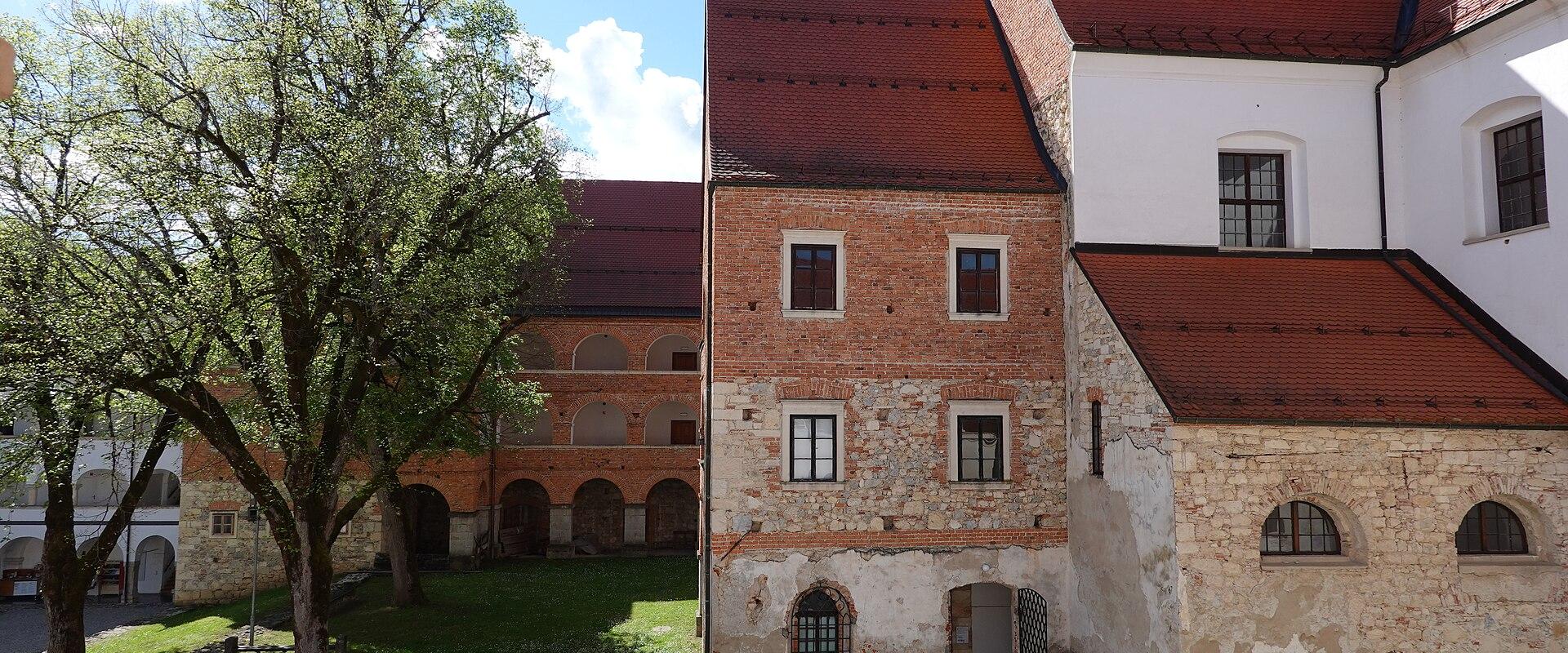
Cistercian monastery
13th-century Cistercian monastery on Krka River island
- Where
- Kostanjevica na Krki, Dolenjska
- Directions
- Directions
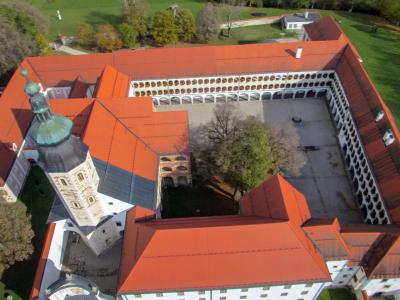
The Cistercian monastery in Kostanjevica na Krki, known in Latin as Fons Sanctae Mariae, the Spring of St Mary, was founded in 1234 by Bernhard of Spanheim, Duke of Carinthia, and it grew into one of the largest and most important monasteries in the Slovene lands. It stands on the edge of the small island town of Kostanjevica, on the Krka river in Lower Carniola, in a landscape of flat river meadows with the Gorjanci hills behind. The Cistercians were a reforming order that favoured simple, austere buildings and settled in quiet, often marshy places, which they drained and farmed, and this site matches that pattern closely.
The monastery was for several centuries a centre of religion, farming and learning. The monks worked the surrounding land, kept a library and ran a school, and the abbey church was one of the grandest in the region, a large three-aisled building with a long nave. The complex passed through many changes: it was damaged by the Ottoman raids of the fifteenth and sixteenth centuries, rebuilt, and given Baroque additions, before being dissolved at the end of the eighteenth century, when Emperor Joseph II closed many monasteries across the Habsburg lands. After that, the buildings were used for a variety of purposes, and the complex fell into disrepair until restoration in the twentieth century.
Today the monastery has found a new life as a cultural centre. Its cloisters, halls and church are used for exhibitions, concerts and events, and the complex houses the Božidar Jakac Art Museum, which presents the work of one of the best-known Slovene graphic artists, as well as a collection linked to the Forma Viva sculpture project, in which large wooden sculptures have been carved in the oak forests nearby since the early 1960s. Walking through the cloisters, you can see the thick stone walls and plain vaults that reflect the Cistercian ideal of restraint, and the grounds give a sense of the order's relationship with the land.
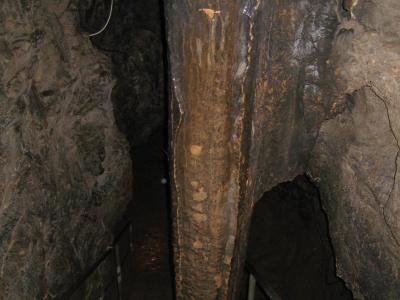
The monastery is the main sight in Kostanjevica, but the surroundings offer more. Cerkev Sv. Jakoba, the parish church of St James, stands in the town centre, and Kostanjevica Cave and the Krakovo Forest, known for its ancient oaks, including the Cvelbar Oak, lie nearby. Romarska is a further stop for visitors who want to explore on foot. Opening arrangements vary by season and by event, so check locally before visiting.
Categories
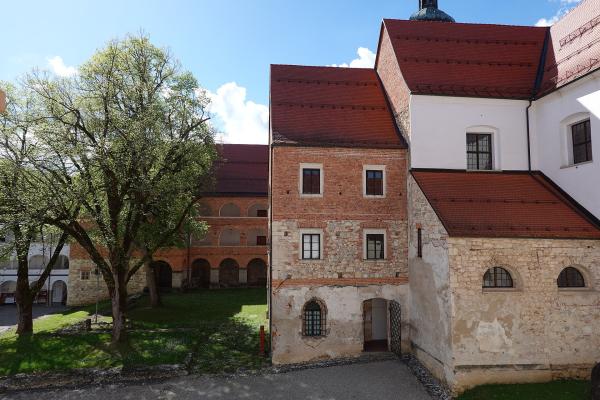
More photos coming soon
Nearby Attractions
Other places to visit in Kostanjevica na Krki
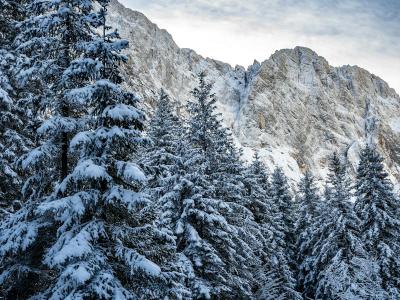
Krakovo Forest
Historic forest mapped by inventor Josef Ressel
Natural Wonders · Guided Tours
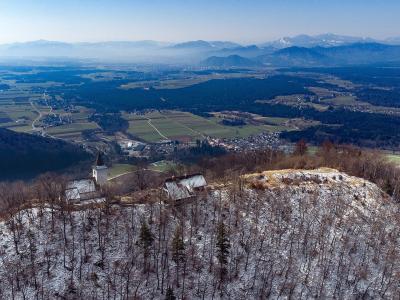
Cerkev Sv. Jakoba
Medieval Baroque church on Slovenia’s Krka River island
Churches · Historic Towns
Božidar Jakac Art Museum
Slovenian modern art in a medieval monastery
Historic Houses · Museums
Kostanjevica Cave
Natural cave opened by underground waters in 1937
Caves · Geological Sites
Questions people ask
Quick Facts
Best Time to Visit
May to September offers warm weather for river activities, art events, and outdoor exploration; spring and autumn are mild and scenic.
Book your stay