- Where
- Logarska Dolina, Gorenjska
- Directions
- Directions
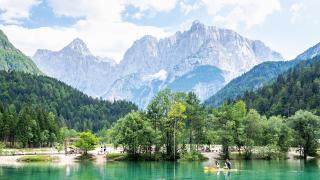
At the head of the Logar Valley, the green meadows and farms give way to a wall of rock, and over the wall pours the Rinka waterfall, one of the best-known natural sights of the Slovenian Alps. The waterfall, which falls about ninety metres in a spreading, veil-like cascade, is fed by the spring that forms the source of the Savinja River, and above it rises the massif of Mount Rinka, a peak of well over two thousand metres on the border with Austria. The scene is set in a glacial cirque, the amphitheatre of rock carved by ice at the end of the valley, and standing at its foot you feel as if the valley ends in a cathedral of stone.
The waterfall is a good example of a typical limestone landscape. Water that falls as rain and snow on the plateau above sinks into the porous rock and flows through it underground, to re-emerge at the foot of the cliff. In the case of the Rinka, the water comes out of the rock face and falls in a thin, fan-like cascade, which is sometimes described as a horsetail waterfall, since it spreads and thins as it drops. In spring and after rain it is powerful and roars, while in dry weather in late summer it can shrink to a thin veil, and in winter it freezes into curtains of ice. The Savinja springs close by, in an ice-cold source at an altitude of around 1,280 metres, and the river begins its journey from here through the valleys of Štajerska to join the Sava at Zidani Most.
Reaching the waterfall is a pleasant outing. A path follows the valley floor towards the head of the valley, and from the valley's end a well-trodden trail climbs through forest to a viewpoint at the foot of the falls. The walk takes a couple of hours from the valley entrance, less if you drive to the car park near the end, and the final stretch involves a steady climb on a path with some steps, so wear sturdy shoes and carry water. The route is generally considered easy to moderate and suits families and casual walkers, with continuous views of the mountain walls on either side, among them Strelovec and Ojstrica. In wet or icy conditions the path can be slippery, and it should be avoided in winter without proper equipment.
Beyond the falls, the cirque is the gateway to high alpine routes that lead to peaks, passes and huts, and these are for experienced mountaineers with the proper equipment and a good forecast. For most visitors, the great pleasure is simply to stand at the foot of the cascade and feel the cool mist, listen to the roar and look up at the mountain.
There is no fee for the trail, though vehicles entering the valley are charged. The waterfall suits families, walkers and photographers. Visit in early summer when the flow is strong. Rinka Peak stands over the Rinka Waterfall and the Rinka Cirque, in Logarska Dolina, at the end of the Kamnik-Savinja Alps' longest valley. Visitors will find Slovenia’s most dramatic spring here.
Categories
More photos coming soon
Nearby Attractions
Other places to visit in Logarska Dolina
Kamnik-Savinja Alps
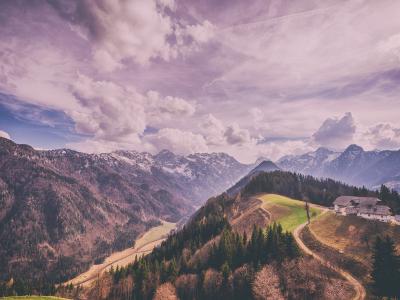
Glacial valley in the Kamnik-Savinja Alps
Activities & Adventure · History & Heritage
Logarska Dolina Alpine Meadow
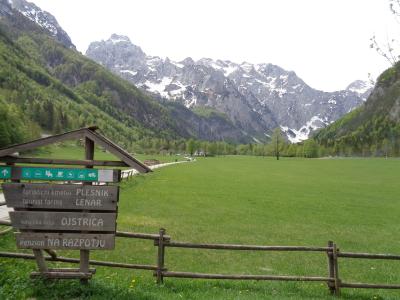
Glacial valley with alpine meadows in Slovenia
Hiking Trails · Hills & Valleys
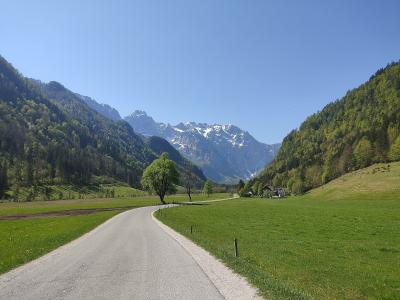
Logarska Dolina Nature Park
Natura 2000 valley with waterfalls and historic farmsteads
Hiking Trails · Hills & Valleys
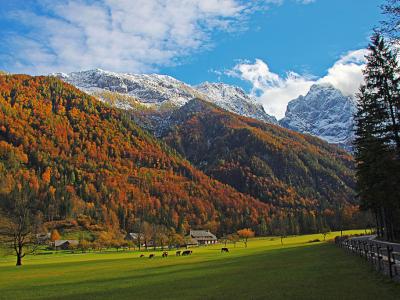
Logarska Dolina Visitor Center
Visitor center for Slovenia Green Park
Cycling Routes · Hiking Trails
Questions people ask
Quick Facts
Best Time to Visit
June to September offers warm weather ideal for hiking, while winter brings snow for skiing.
Book your stay